From perspective drawing to modern graphics
Doubts may arise regarding the link between historical drawing tools and modern 3D technology established in this analysis. However, this perspective offers an excellent point of observation, much like the methods used by historical masters to manage perspective projection in their drawings.
As you may know, the artist, a member of the craftsmen's guild, was more than just a plasterer or painter. He was a skilled professional capable of drafting architectural plans for fortifications, designing military and hydraulic projects, and creating utility furniture and other goods. His talent served him in illustrating ideas and prototypes. Essentially, this represents a historical form of architectural visualization, product design, and texturing.
There are a number of tools and techniques used by artists that deal with perspective projection in much the same way as modern software and 3D graphics do. We can think of this as mathematical precision in art.
Artist-engineers often constructed tools to understand proportions and define vanishing points, orthogonals, and transversals. For example, take a look at the picture of a perspective window device:
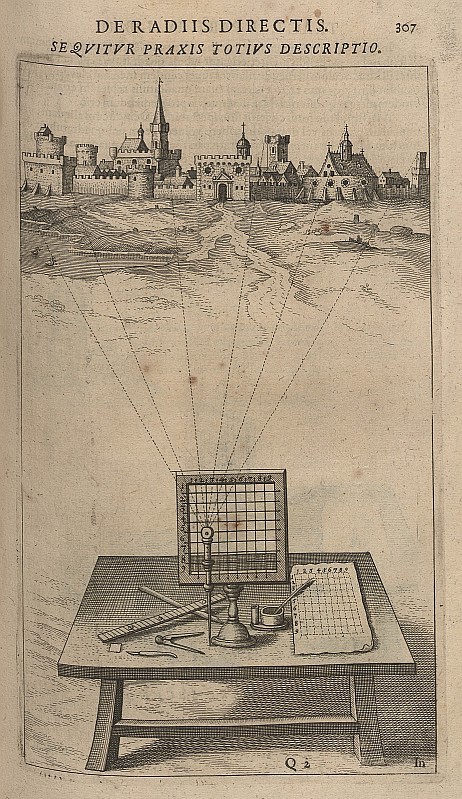
A 17th-century perspective drawing tool known as Alberti's Grid uses a sheet of paper divided into a corresponding grid, ensuring accurate proportions of a landscape, city, or building.
Here, we can see steps similar to those used by 3D engines: creating a view frustum, projecting 3D into 2D, and performing a form of rasterization — a grid mapped onto paper.
Another important piece of equipment was the Camera Lucida:
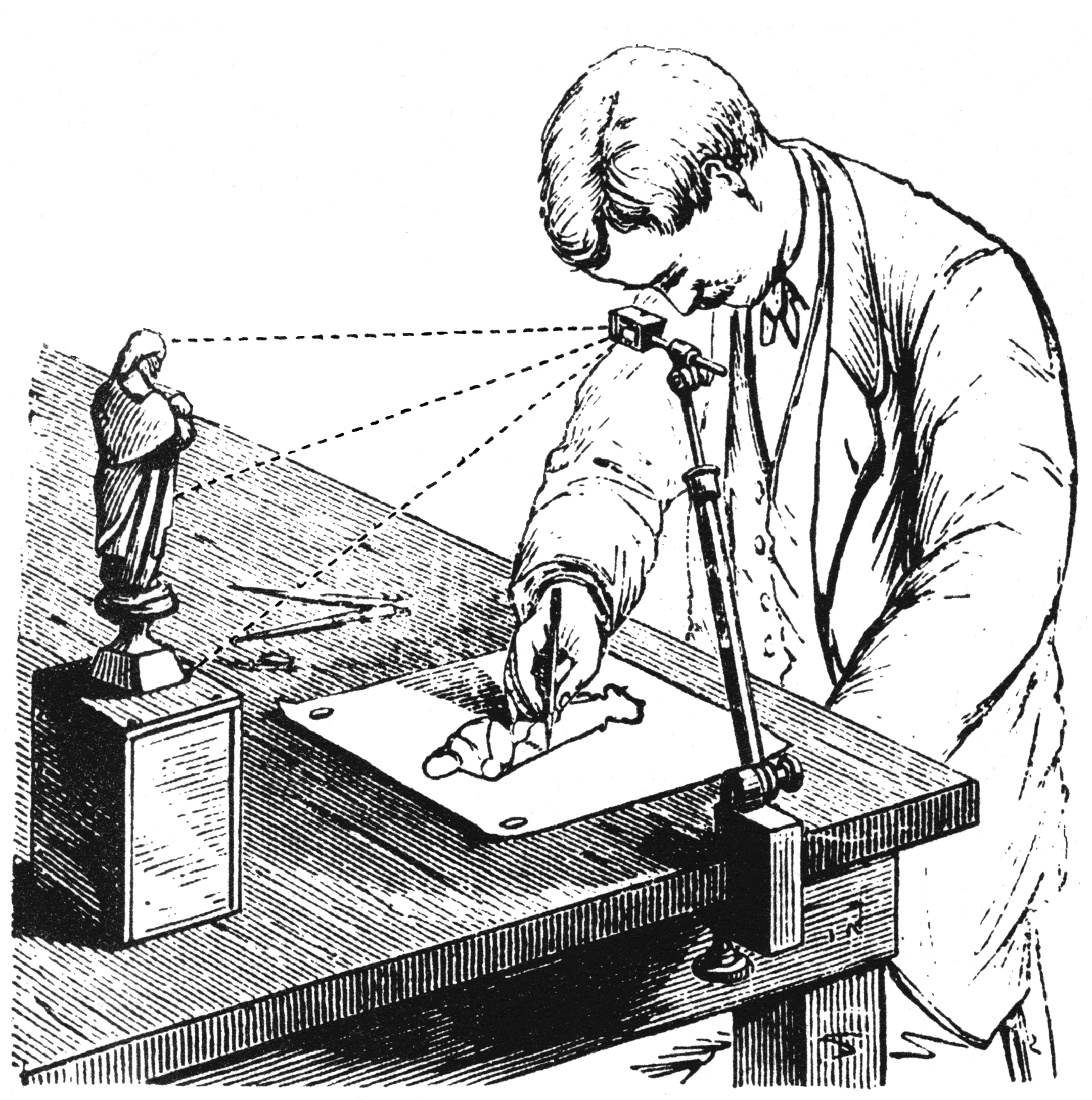
It uses a prism or a series of mirrors to superimpose an image of a subject onto a drawing surface.
It is also worth mentioning the Camera Obscura:
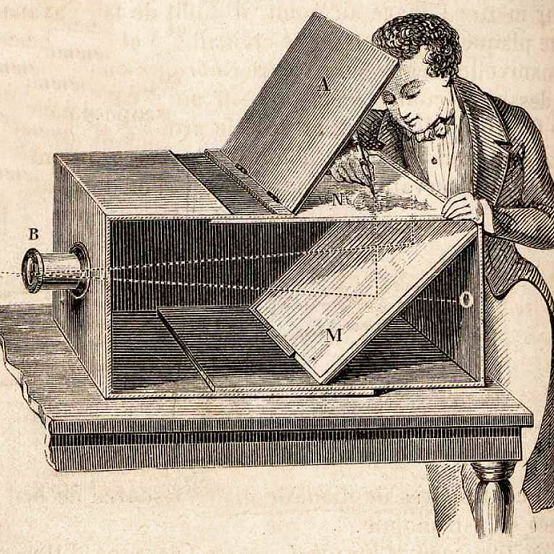
The Camera Obscura is the optical predecessor of the modern camera. While the Camera Lucida is a portable daylight tool, the Camera Obscura involves a box in which light from the outside passes through a small hole (or lens) to project an image onto a surface.
All this equipment serves one aim: translating real-world shapes into an imaginary space that models how humans actually perceive the world (a perceptual structure), while maintaining proportions and the illusion of depth, and then projecting them onto a 2D plane, whether it be paper or a device screen, as in 3D software.